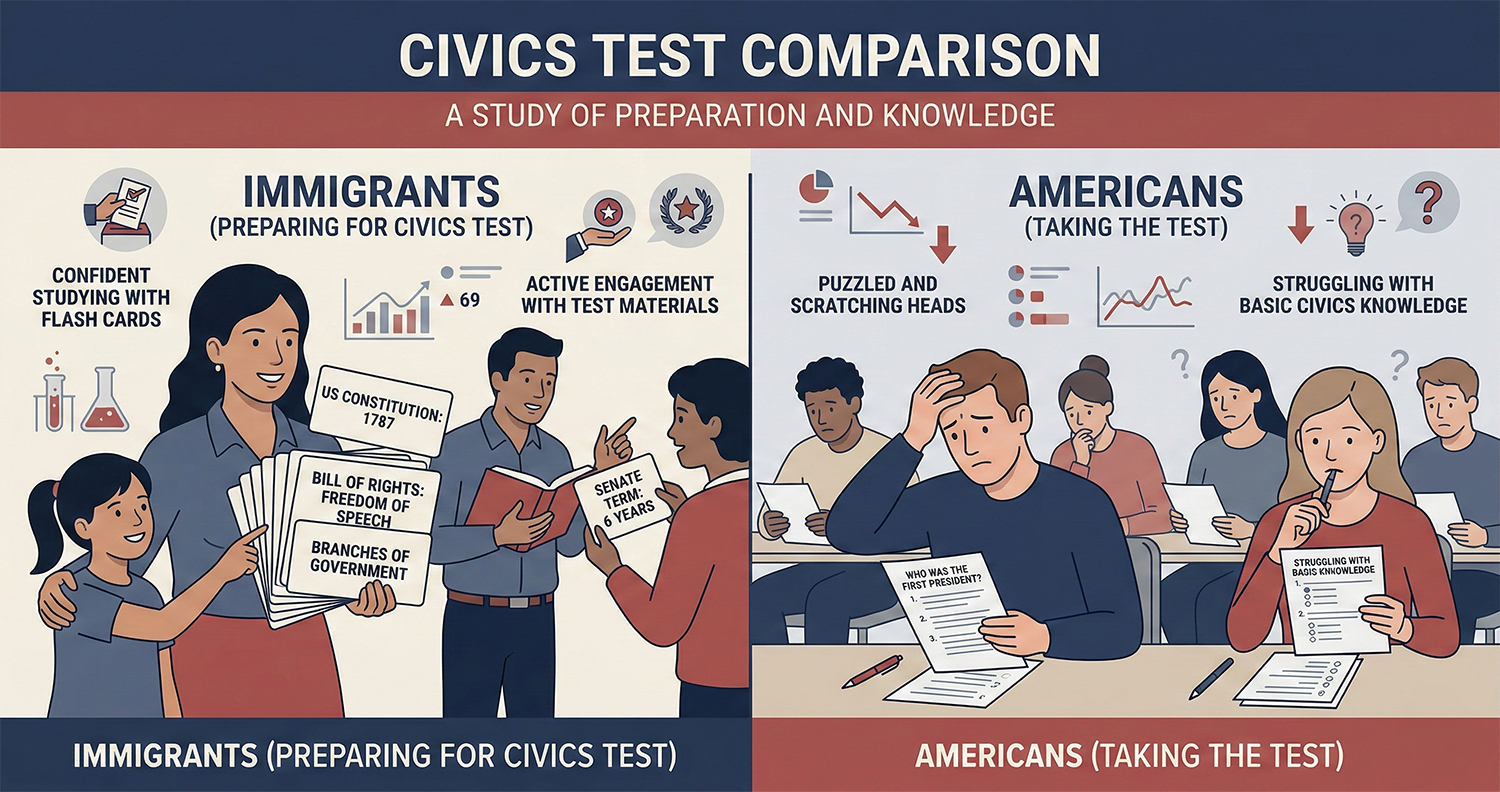
Every year, hundreds of thousands of immigrants sit across from a USCIS officer and answer questions about American government and history. They study for months. They memorize the names of Supreme Court justices, the rights guaranteed by the First Amendment, and the number of amendments to the Constitution. And 91% of them pass on the first try.
Meanwhile, when a national survey posed the same questions to native-born American adults, nearly two out of three failed.
That gap — between the people earning citizenship and the people born into it — tells a story about what Americans know about their own country, who takes civic knowledge seriously, and why it matters more right now than it has in decades.
Key Findings
- 64% of native-born American adults failed a multiple-choice civics test based on the naturalization exam, according to a 1,000-person survey by the Woodrow Wilson Foundation (2018).
- 91.2% of immigrants pass the civics portion of the naturalization test on their first attempt, per USCIS data (FY 2022).
- Only 19% of Americans under 45 passed, compared to 74% of those 65 and older — a 55-point generational gap (Woodrow Wilson Foundation, 2018).
- In a 50-state survey of 41,000 Americans, only Vermont had a majority who could pass. The bottom five states scored between 27% and 32% (Woodrow Wilson Foundation, 2019).
- Only 22% of U.S. eighth-graders scored proficient or above on the 2022 NAEP civics assessment — the first decline in scores since 1998 (NAEP, 2023).
Where the Data Comes From
This article synthesizes findings from multiple sources. No single survey tells the full story, so we've drawn from government data, academic research, and large-sample surveys conducted between 2012 and 2025:
- USCIS Naturalization Test Performance Data — Official pass/fail rates for immigrant applicants. FY 2022 data. Tier 1 source.
- Woodrow Wilson National Fellowship Foundation — Survey of 1,000 adults (2018) and follow-up 50-state survey of 41,000 adults (2019). Tier 2 source.
- Xavier University Center for the Study of the American Dream — Survey of 1,023 native-born citizens using actual naturalization test questions (2012). Tier 2 source.
- Annenberg Public Policy Center, University of Pennsylvania — Annual Constitution Day Civics Survey tracking civic knowledge from 2006 to 2025. Tier 1 source.
- National Assessment of Educational Progress (NAEP) — Federal assessment of eighth-grade civics knowledge (2022). Tier 1 source.
- U.S. Chamber of Commerce Foundation / The Civic Trust — Survey of 2,000 registered voters (2023). Tier 2 source.
Different surveys use different methodologies — some are multiple choice, some open response, and sample sizes range from 1,000 to 41,000. The overall pattern, however, is consistent across all of them.
The Numbers That Define the Gap
The contrast between immigrant and native-born performance isn't subtle.
When Xavier University tested 1,023 native-born citizens on actual naturalization questions in 2012, one in three failed outright. The study found that 85% could not explain "the rule of law," 75% could not describe what the judicial branch does, and 71% did not identify the Constitution as the supreme law of the land.
Immigrants taking the same test through USCIS passed at a rate of 91.2% on the first attempt — and 95.7% when including re-examinations, according to FY 2022 government data.
"The average American is woefully uninformed regarding America's history and incapable of passing the U.S. Citizenship Test. It's an embarrassment," said Arthur Levine, then-president of the Woodrow Wilson Foundation, when releasing the 2018 survey results.
But embarrassment isn't the only takeaway. The more interesting question is: what does it say about the people who do pass?
What Immigrants Study (and Americans Don't)
The naturalization test, in its 2008 version used through October 2025, drew from a pool of 100 civics questions. A USCIS officer asked up to 10 of them orally. Applicants needed 6 correct answers to pass — a 60% threshold.
As of October 20, 2025, USCIS expanded the test to 128 questions. Officers now ask up to 20, and applicants must answer 12 correctly. Roughly 75% of the questions carried over from the old version. New questions cover topics like the Persian Gulf War, the Vietnam War, and civil rights milestones.
Immigrants preparing for this test study. They attend citizenship classes, use USCIS flash cards, take practice exams, and quiz each other. Many study for three to six months. They treat the test as what it is: a meaningful threshold.
For native-born Americans, no such threshold exists. Civic knowledge is assumed — and that assumption is increasingly wrong.
The Generational Divide Is Stark
The Woodrow Wilson Foundation's 2018 survey revealed a 55-percentage-point gap by age. Among Americans 65 and older, 74% passed the civics quiz. Among those under 45, only 19% did.
This isn't a matter of older Americans being smarter. It reflects a structural change in education. Only 49% of eighth-graders report taking a dedicated civics class, according to NAEP data. And only 29% have a teacher whose primary responsibility is teaching civics.
The NAEP's 2022 assessment confirmed the downstream effect: just 22% of eighth-graders scored proficient or above in civics, and nearly one-third fell below the basic level — meaning they could not describe the structure and function of government at all. Scores dropped 2 points from 2018, marking the first decline since testing began in 1998.
"In a democratic society, such knowledge must include a firm understanding of our nation's history and civic institutions," said Patrick Kelly, a NAGB member and AP Government teacher, in response to the 2022 results. "Today's results show there is much work to be done."
The education gap compounds the age gap. Xavier University's study found that 82% of college graduates passed versus only 44% of those with a high school education or less — a 38-point spread.
The Geography of Civic Knowledge
The Woodrow Wilson Foundation's 50-state survey of 41,000 Americans in 2019 mapped civic knowledge across the country. Only one state — Vermont, at 53% — had a majority who could pass.
The bottom five states were Louisiana (27%), Kentucky, Arkansas, Alabama, and Mississippi. The top performers — Wyoming, South Dakota, Montana, and Virginia — clustered in the low 50s.
This geographic variation correlates with an uneven policy picture. As of 2024, 20 states require students to pass a civics test to graduate from high school, many modeled on the USCIS naturalization exam itself. Eight states have neither a civics course nor a test requirement: Alaska, Delaware, Kansas, Maine, New Jersey, Rhode Island, Vermont, and Wyoming, according to data from the Hoover Institution.
The irony is hard to miss: Vermont requires no civics test and still leads the nation in civic knowledge. Louisiana does require one — and ranks last. The relationship between policy and outcomes is complicated.
A 20-Year Arc: Some Good News
Not all the data trends downward. The Annenberg Public Policy Center at the University of Pennsylvania has tracked civic knowledge annually since 2006. In that first year, only 26% of American adults could name all three branches of government.
By 2025, that figure reached 70% — the highest point in two decades.
But the trajectory wasn't a straight line. Knowledge dipped during election years when misinformation spiked and rebounded in quieter periods. In 2022, only 47% could name all three branches — down from 56% in 2021 — and 26% could not name a single right protected by the First Amendment.
"People can't cherish, safeguard, or exercise their constitutionally protected rights unless they know that they have them and understand how effective use of them sustains our system of government," said Kathleen Hall Jamieson, director of the Annenberg Public Policy Center.
The 20-year data suggests that civic knowledge isn't fixed. It responds to events, education, and public attention. It can improve. It can also erode.
What Questions Stump Americans Most?
When the Woodrow Wilson survey tested specific questions, the results revealed which topics Americans struggle with most:
Question Topic% Who Got It WrongCountries the U.S. fought in WWII60%Number of Supreme Court justices57%Who wrote the Federalist Papers73%When the Constitution was ratified87%What the Electoral College does52%
These aren't obscure facts. They're the same questions immigrants study and answer correctly at a 91% clip. The difference isn't ability — it's preparation.
Why This Matters Right Now
In FY 2024, 818,500 immigrants became U.S. citizens — a 12% increase over the 2010–2019 annual average of 730,100. More than 7.9 million people have naturalized in the past decade, according to USCIS. These new citizens arrive having demonstrated civic knowledge that most native-born Americans cannot match.
This fact isn't a criticism of anyone. It's an observation about incentives and investment. Immigrants study because the test is a gate. Americans don't study because there is no gate. But the knowledge itself — understanding your rights, knowing how your government works, recognizing what the Constitution guarantees — serves everyone equally.
The U.S. Chamber of Commerce Foundation's 2023 survey of 2,000 registered voters found that over 70% failed a basic civic literacy quiz. Only half could identify the legislative branch as the place where bills become law. One-third didn't know the three branches of government exist.
"Put plainly, you can't fix what you don't understand," said Hilary Crow, Head of The Civic Trust at the U.S. Chamber Foundation.
What's Changing
The civic education picture is shifting. Federal funding for K–12 civics tripled from $7.75 million in 2022 to $23 million in 2024, though proposed FY2026 budget cuts could reverse that gain. The bipartisan Civics Secures Democracy Act, sponsored by Senators Chris Coons and John Cornyn, proposes $1 billion annually for civics programs at every level of education.
At the state level, momentum is building. In 2025, 45 states are considering 198 bills related to K–12 civic education, with over 70% classified as bipartisan, according to the National Conference of State Legislatures.
And the naturalization test itself just got harder — raising the bar for immigrants while the bar for native-born Americans remains where it has always been: nonexistent.
What This Means for You
The naturalization test isn't a trivia game. It covers the mechanics of how American democracy functions — the same mechanics that determine policy, rights, and representation for everyone.
Whether you were born here or earned your citizenship through study and ceremony, the knowledge tested by those 128 questions belongs to all of us. The data suggests we should treat it that way.
If you're curious where you'd land, the full list of questions is available on the USCIS website. Take the test. You might surprise yourself — in one direction or the other.