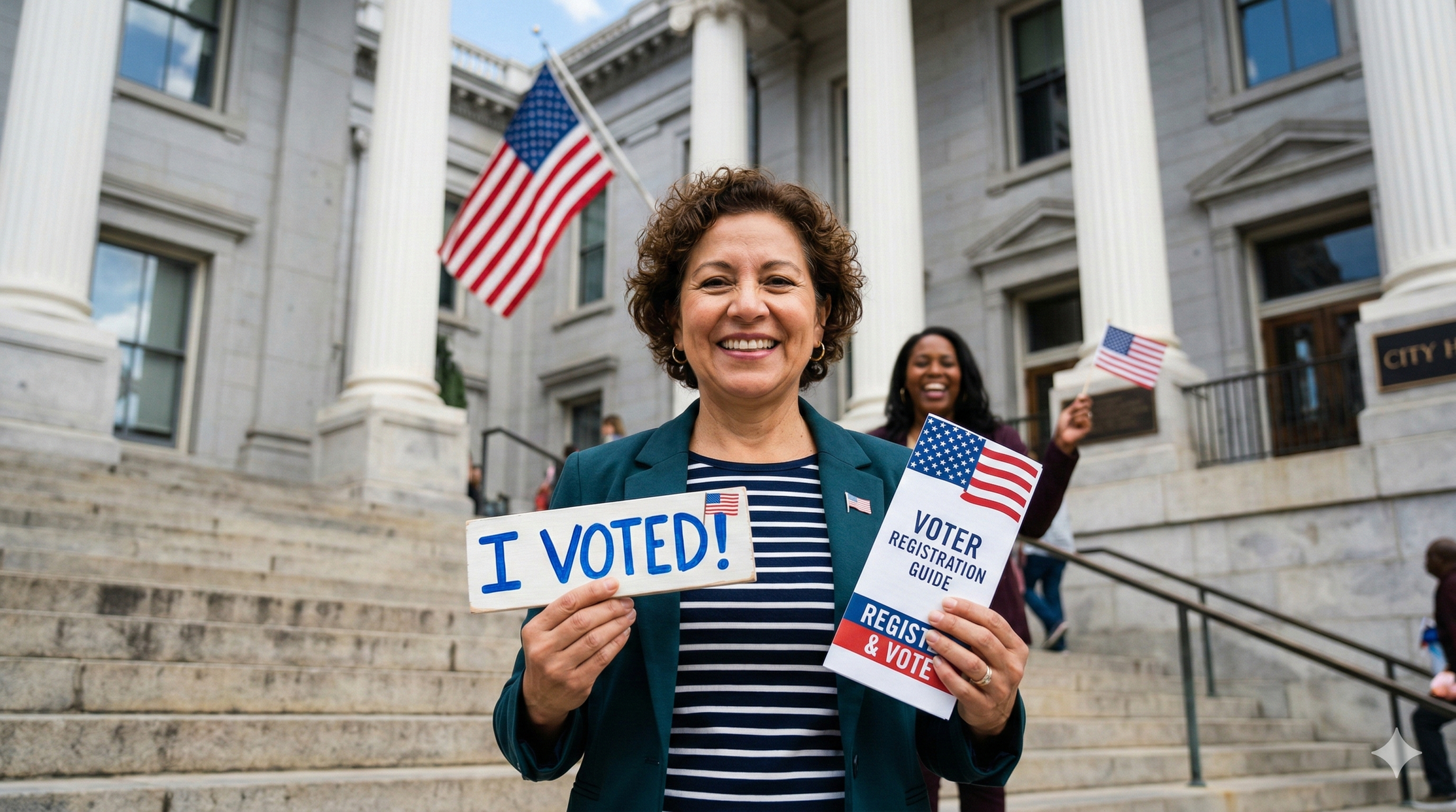
You raised your right hand. You took the Oath of Allegiance. You're an American citizen now — and that means you get to do something millions of people around the world can only dream about: choose your leaders.
But here's the thing. Becoming a citizen doesn't automatically put you on the voter rolls in most states. You still need to register. The good news? It's straightforward, and you have several ways to do it. About 174 million Americans are registered to vote, according to the U.S. Census Bureau's 2024 Current Population Survey — and you should be one of them.
This guide walks you through every step.
What You Need Before Starting
Before you register, gather these items:
- Your Certificate of Naturalization (Form N-550 or N-570) — this is your proof of citizenship
- A state-issued ID or driver's license — required in most states for online registration
- Your Social Security number — some states ask for the full number, others only the last four digits
- Your current residential address — this determines your polling location and eligible races
If you don't have a state ID yet, that's fine. You can register by mail in 46 states and the District of Columbia using the National Mail Voter Registration Form from the U.S. Election Assistance Commission (eac.gov).
Step 1: Check If You're Already Registered
Some states have automatic voter registration (AVR). If you got your driver's license or state ID after becoming a citizen in one of the 24 states (plus D.C.) that use AVR, you might already be registered. Oregon and California pioneered this system in 2015, and states like Delaware, Minnesota, and Pennsylvania joined as recently as 2023, according to the National Conference of State Legislatures.
How to check: Visit your state's Secretary of State website or go to vote.org/am-i-registered-to-vote to look up your name.
If your name appears, confirm that your address and party affiliation (if applicable) are correct. If it doesn't, move to Step 2.
Step 2: Pick Your Registration Method
You have four ways to register, and 43 states plus D.C. now offer online registration, according to the NCSL. Here's a breakdown:
Online registration — Available in 43 states and D.C. You'll need a state-issued ID with a signature on file. The process takes about 5 minutes. Visit your state's election website or use vote.gov to find the link.
By mail — Download the National Mail Voter Registration Form from eac.gov. Print it, fill it out, and mail it to the address listed for your state. Available in 46 states and D.C. (New Hampshire, North Dakota, Wisconsin, and Wyoming don't accept it.) Allow 2-4 weeks for processing.
In person — Walk into your county election office, your local DMV, or a designated government agency. The National Voter Registration Act of 1993 requires motor vehicle agencies and public assistance offices to offer registration in 44 states plus D.C., according to the U.S. Department of Justice.
Same-day registration — In 22 states and D.C., you can register and vote on the same day, including on Election Day. North Carolina allows same-day registration only during early voting. Check the NCSL's same-day registration page for your state's rules.
Tip: If English isn't your primary language, many state election offices provide registration materials in Spanish, Chinese, Vietnamese, Korean, and other languages. Section 203 of the Voting Rights Act requires translated materials in jurisdictions where a single language minority group exceeds 5% of the voting-age population or numbers more than 10,000 citizens.
Step 3: Fill Out the Registration Form
Whether online, by mail, or in person, the form asks for the same basic information:
- Full legal name — Use the name on your Certificate of Naturalization
- Date of birth
- Residential address — Must be where you actually live, not a P.O. Box (a separate mailing address field handles P.O. Boxes)
- Citizenship confirmation — You'll check a box confirming you're a U.S. citizen
- ID number — Your state ID or driver's license number, or the last four digits of your Social Security number
- Signature — For online forms, your signature from your state ID is used; paper forms require a physical signature
- Party affiliation — Required in some states (for primary elections), optional in others
Double-check every field. A typo in your name or address is the most common reason applications get delayed or rejected.
Step 4: Know Your Deadlines
Registration deadlines vary by state, and missing yours means you can't vote in that election. Here's the general pattern:
- Same-day registration states (22 + D.C.): You can register up to and including Election Day
- Most other states: Deadlines fall 15 to 30 days before the election
- Federal elections in 2026: The next major federal election is the November 2026 midterms — check your state's deadline now
You can find your exact deadline at vote.gov or your state's Secretary of State website.
Plan ahead. If you're registering by mail, your application generally must be postmarked by the deadline — not received. But give yourself a buffer. Mailing it at least a week early avoids last-minute problems.
Step 5: Confirm Your Registration and Find Your Polling Place
After submitting your registration, you should receive a confirmation — either by email (for online registration) or by mail (a voter registration card). This typically arrives within 2-4 weeks.
If you don't hear back within a month, contact your county election office directly. Don't assume you're registered. The Census Bureau's 2024 data shows that 73.6% of the citizen voting-age population was registered that year, but 26.4% was not — and some portion of those people believed they were.
Once confirmed:
- Find your polling place at vote.gov or your state's election site
- Check what ID you'll need to vote — requirements vary from no ID to strict photo ID
- Review your sample ballot so you recognize the races and candidates before you step into the booth
Why This Matters More Than You Might Think
Here's a number worth sitting with: naturalized citizens made up about 9% of all voters in the 2024 presidential election, according to Pew Research Center. That's roughly 24 million eligible voters. Between 2012 and 2022, the number of naturalized citizens eligible to vote grew 32%, while the native-born eligible population grew just 8%.
Your vote carries weight. In Georgia's 2020 presidential race, the margin of victory was roughly 12,000 votes. During that same period, the state had more than 96,000 recently naturalized citizens, according to Brookings Institution research.
But there's a gap. In the 2022 midterm elections, native-born citizens turned out at 53.4%, while naturalized citizens voted at just 41.4%, according to Census Bureau data. That 12-point gap represents hundreds of thousands of voices going unheard — on immigration policy, education, healthcare, and every other issue that affects your community.
One more thing: registering to vote at naturalization ceremonies has become more difficult. In August 2025, USCIS changed its policy to no longer allow third-party organizations like the League of Women Voters to assist with voter registration at administrative ceremonies. Previously, the League alone registered over 37,000 new citizens at nearly 800 ceremonies in 2022. That channel is now closed, which makes it even more important to register on your own.
Troubleshooting
"My name doesn't match my documents." If your naturalization certificate has a different name than your state ID (a common situation after name changes during the citizenship process), update your state ID first at the DMV, then register with your current legal name.
"I moved to a new state." You need to re-register in your new state. Your old registration doesn't transfer. Most states let you register online with your new address and state ID within minutes.
"I was told I can't register." If you're a U.S. citizen, 18 or older, and meet your state's residency requirements, you have the legal right to register. If an election official tells you otherwise, ask to speak with a supervisor, contact your state's Secretary of State office, or call the Election Protection Hotline at 866-OUR-VOTE (866-687-8683).
Your Next Step
You've earned the right to vote. Now use it. Pick the registration method that works for you — online takes five minutes — and complete it today. The 2026 midterm elections are coming, and your voice belongs in the count.
Have you recently registered after becoming a citizen? What part of the process surprised you?