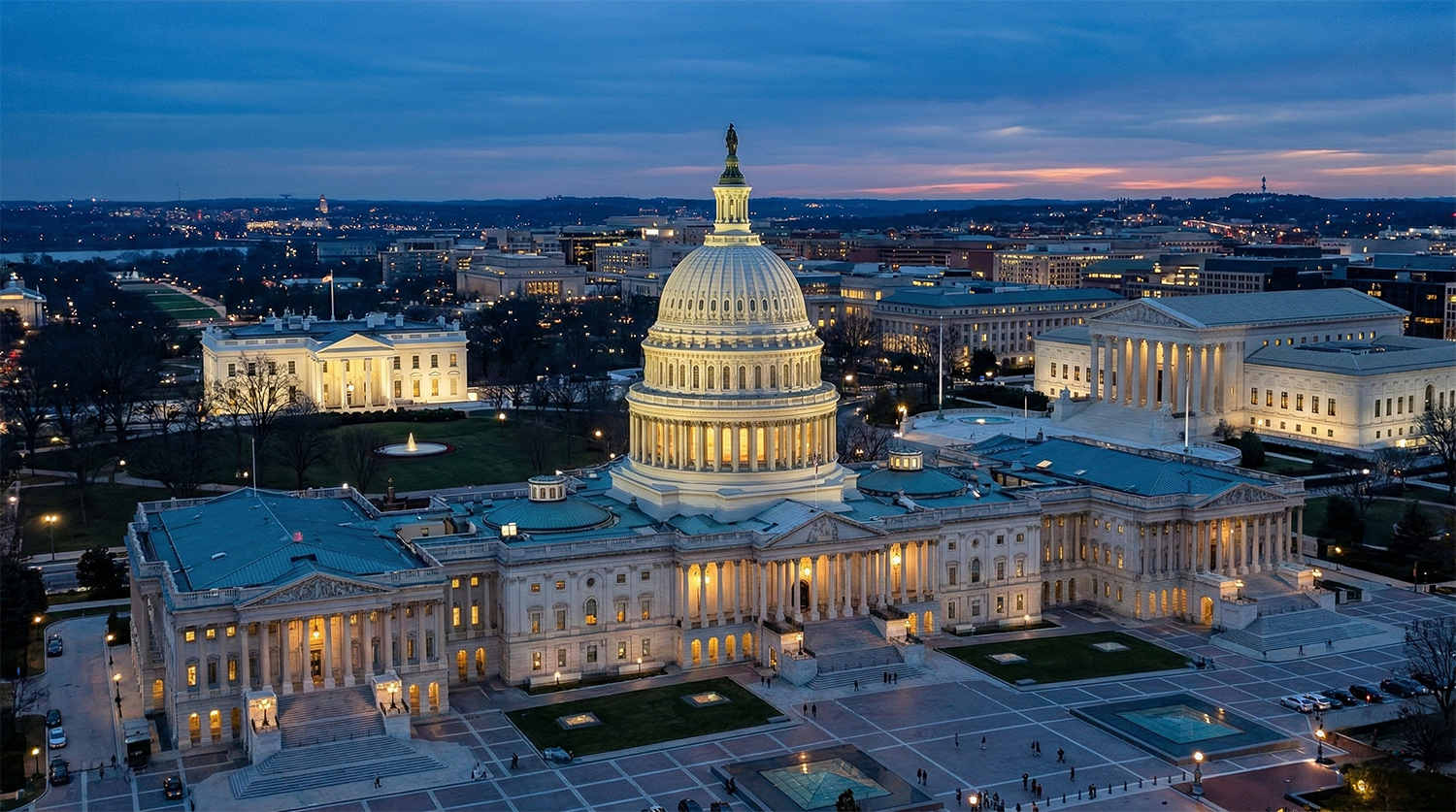
A 2025 Annenberg Public Policy Center survey found that 70% of Americans can name all three branches of government — the highest percentage ever recorded. But naming them and understanding how they hold each other accountable are different things entirely.
Introduction
The U.S. Constitution doesn't just create a government. It builds a system of structured tension — three branches designed to push back against one another so that no single person or group accumulates too much power.
James Madison explained the logic in Federalist No. 51: "Ambition must be made to counteract ambition." The Framers had lived under a king. They didn't trust concentrated authority, so they split governing power three ways and gave each branch tools to slow down, block, or override the others.
This article breaks down what each branch does, how the checks between them actually work, and why real examples from American history — including cases from 2024 and 2025 — prove the system is still operating under pressure.
What Does Each Branch Actually Do?
Each branch draws its authority from a separate article of the Constitution, and each has a distinct role.
Article I — Congress (the Legislative Branch) writes and passes federal laws. Congress holds the power to tax, spend, declare war, and regulate commerce. It also conducts oversight of the executive branch and confirms presidential appointments. Congress consists of two chambers: the Senate (100 members, two per state) and the House of Representatives (435 members, apportioned by population).
Article II — the President (the Executive Branch) enforces the laws Congress passes. The President serves as commander-in-chief, negotiates treaties, and appoints federal judges and Cabinet officials. Executive agencies — from the Department of Education to the Environmental Protection Agency — carry out the daily business of implementing federal policy.
Article III — the Courts (the Judicial Branch) interprets the law and resolves disputes. The Supreme Court sits at the top, with authority over federal appeals courts and district courts below it. Federal judges serve lifetime appointments during "good Behaviour," a deliberate choice by the Framers to shield the judiciary from political pressure (National Archives, "The Constitution: What Does it Say?").
The separation isn't perfectly clean. The branches overlap by design — that overlap is where checks and balances live.
How Do the Branches Check Each Other?
Checks and balances operate as a web of reciprocal powers. Each branch can restrain the other two in specific, enumerated ways.
Congress Checking the President
Congress holds the most direct tools for restraining executive power:
- The veto override. When the President vetoes a bill, Congress can override it with a two-thirds vote in both chambers. Since 1789, presidents have issued 2,599 vetoes. Congress has overridden just 112 of them — about 4.3% — which shows how hard it is in practice but confirms the tool exists and works (U.S. Senate, "Summary of Vetoes").
- Impeachment. The House can impeach a president by simple majority, and the Senate tries the case with a two-thirds vote needed for conviction. Three presidents have been impeached: Andrew Johnson in 1868, Bill Clinton in 1998, and Donald Trump in 2019 and again in 2021. None were convicted, but the process itself forced public accountability each time (U.S. Senate, "About Impeachment").
- Confirmation power. The Senate must approve Cabinet members, ambassadors, and Supreme Court justices. The Senate has rejected 9 Cabinet nominees and blocked or declined to act on multiple Supreme Court nominations throughout American history (U.S. Senate, "About Nominations").
- The power of the purse. Congress controls all federal spending. The executive branch cannot spend a dollar that Congress hasn't authorized — a check that shows up in every budget negotiation and government shutdown debate.
The President Checking Congress
The President's primary check on Congress is the veto. Franklin D. Roosevelt holds the record at 635 vetoes across his four terms. A single veto can stop legislation unless both chambers of Congress find the supermajority votes to override (U.S. House History, "Presidential Vetoes").
The President also shapes policy through executive orders — directives that carry the force of law within the executive branch. These orders can set priorities and direct agencies, though they cannot create new law or override existing statutes.
The Courts Checking Both Branches
The judiciary's most powerful tool is judicial review: the authority to strike down laws or executive actions that violate the Constitution. This power isn't written explicitly in the Constitution — it was established in Marbury v. Madison (1803), when Chief Justice John Marshall declared that "it is emphatically the province and duty of the judicial department to say what the law is" (National Archives, "Marbury v. Madison").
Since then, the Supreme Court has struck down portions or entirety of approximately 182 Acts of Congress (Congress.gov, "Table of Laws Held Unconstitutional").
And the check runs both directions. Congress can impeach federal judges (15 have been impeached, 8 convicted and removed), propose constitutional amendments to override court rulings, and control the judiciary's budget and structure (U.S. House History, "List of Individuals Impeached").
Why Do Checks and Balances Still Matter Right Now?
If you think this system is an artifact from the 1700s, recent events say otherwise. The years 2024 and 2025 produced a series of high-profile collisions between branches that put checks and balances on full display.
The end of Chevron deference (June 2024). In Loper Bright Enterprises v. Raimondo, the Supreme Court overturned a 40-year precedent that required courts to defer to federal agencies when laws were ambiguous. The 6-3 ruling shifted interpretive power from executive agencies back to the judiciary — a major recalibration of the balance between branches (American Bar Association, "The End of Chevron Deference," August 2024).
Presidential immunity ruling (July 2024). In Trump v. United States, the Court ruled 6-3 that presidents have absolute immunity from criminal prosecution for "core" official acts. Justice Sotomayor's dissent warned that the decision "reshapes the institution of the presidency." Whether you agree with the ruling or not, it redrew the line between executive power and judicial accountability (National Constitution Center, "Breaking Down the Trump Immunity Decision").
Courts blocking executive orders (2025). Federal judges blocked several executive orders in early 2025, including an order on birthright citizenship (multiple district courts found it exceeded executive authority under the 14th Amendment) and a federal funding freeze (blocked as an infringement on Congress's spending power). In March 2025, a judge ordered six agencies to reinstate approximately 16,000 terminated probationary employees (Federal Judicial Center, "Judicial Review of Executive Orders").
These aren't abstract constitutional concepts. They're the system working — sometimes messily, sometimes controversially, but working.
How Well Do Americans Actually Understand This System?
The numbers are improving, but gaps remain.
The 2025 Annenberg survey recorded 70% of Americans correctly naming all three branches — up from 65% in 2024 and a record low of 26% in 2016. The researchers noted that the increase coincided with heightened political attention: "a torrent of executive actions and the resulting judicial cases and actions by Congress produced a seemingly nonstop rush of political news" (Annenberg Public Policy Center, September 2025).
But the broader civic knowledge picture is more sobering. A Woodrow Wilson National Fellowship Foundation survey found that only 36% of native-born Americans could pass a basic U.S. citizenship test. Among adults under 45, that number dropped to 19%. Meanwhile, naturalization applicants pass the same test at a 92% rate on their first attempt (USCIS, "Naturalization Test Performance"; Citizens & Scholars, "National Survey").
Trust compounds the problem. A December 2025 Pew Research Center survey found that only 26% of Republicans and 9% of Democrats say they trust the federal government most of the time — down from 73% across parties in 1958 (Pew Research Center, "Public Trust in Government: 1958-2025").
Understanding how the system works doesn't guarantee trust. But it's hard to evaluate whether the system is functioning without knowing what it's supposed to do.
Key Takeaways
- The Constitution distributes power across three branches — legislative, executive, and judicial — each created by its own article and given distinct responsibilities.
- Checks and balances are specific, enumerated powers: vetoes, overrides, impeachment, judicial review, confirmation votes, and the power of the purse.
- The system isn't just theoretical. In 2024-2025 alone, the Supreme Court overturned Chevron deference, ruled on presidential immunity, and federal courts blocked multiple executive orders.
- Civic knowledge is rising (70% can name all three branches in 2025), but only 36% of native-born Americans would pass a citizenship test that naturalization applicants pass at 92%.
- Understanding the structure is the foundation for evaluating whether the system is working as designed.
Conclusion
The three branches of government aren't three separate buildings in Washington. They're three forces designed to resist each other — and that resistance is the point. When Congress investigates the President, when courts strike down a law, when the Senate blocks an appointment, the Framers' design is doing exactly what Madison intended.
The question isn't whether the system works perfectly. It's whether the people who live under it understand it well enough to hold it accountable.
What part of checks and balances do you think most people misunderstand? Share your take — the conversation matters more than the quiz score.
Sources:
- National Archives — The Constitution: What Does it Say?
- Congress.gov — Separation of Powers and Checks and Balances
- U.S. Senate — Summary of Vetoes, 1789 to Present
- U.S. Senate — About Impeachment
- U.S. Senate — About Nominations
- U.S. House History — Presidential Vetoes
- National Archives — Marbury v. Madison (1803)
- Congress.gov — Table of Laws Held Unconstitutional
- U.S. House History — List of Individuals Impeached
- American Bar Association — The End of Chevron Deference (August 2024)
- National Constitution Center — Breaking Down the Trump Immunity Decision
- Federal Judicial Center — Judicial Review of Executive Orders
- Annenberg Public Policy Center — Americans' Knowledge of Civics Increases (September 2025)
- USCIS — Naturalization Test Performance
- Citizens & Scholars — National Survey on Citizenship Test
- Pew Research Center — Public Trust in Government: 1958-2025
- National Constitution Center — Federalist No. 51 (1788)