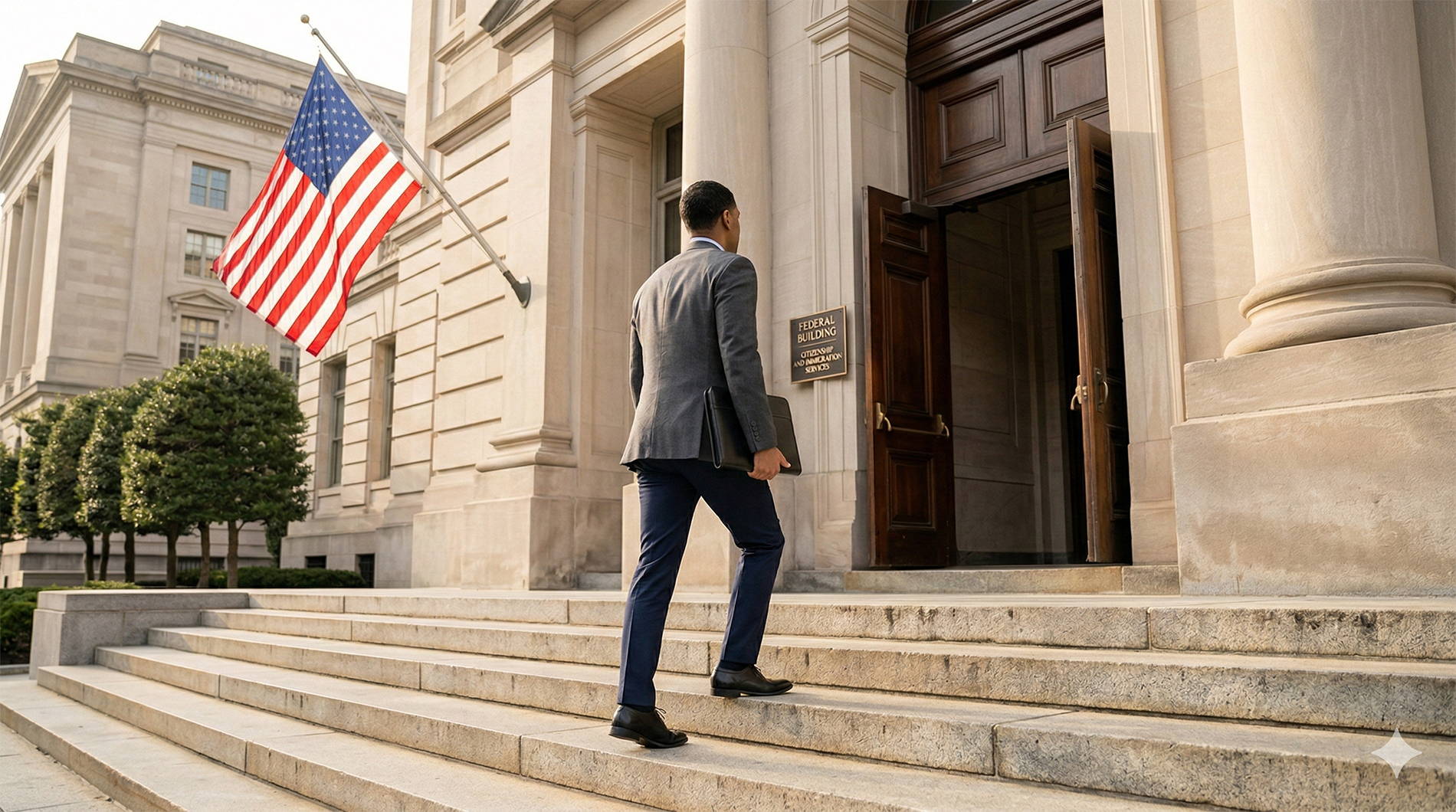
You've waited months for this appointment. The I-797C notice is pinned to your fridge, your documents are in a folder, and your stomach won't stop flipping. The naturalization interview is one of the most anxiety-inducing steps on the path to U.S. citizenship — but it doesn't have to be a mystery.
Here's exactly what happens, from the moment you walk in to the moment you walk out.
What Documents Do You Need to Bring?
Every applicant should arrive with a specific set of documents. Missing even one can delay your case or force a rescheduled appointment.
Required for every applicant:
- Your Form I-797C appointment notice
- Permanent Resident Card (Green Card)
- A valid state-issued photo ID or driver's license
- All passports (current and expired) you've held since becoming a permanent resident
- Any re-entry permits or advance parole documents
Personal records:
- A certified copy of your birth certificate (with a certified English translation if the original is in another language)
- Marriage certificates, divorce decrees, or death certificates for all marriages — past and present
- Selective Service registration confirmation (required for male applicants who were between ages 18 and 26)
Financial and legal records:
- Federal income tax returns or IRS transcripts for the past 3 to 5 years
- Court-certified dispositions for any arrests or charges, including dismissed or expunged cases
- Proof of child support payments, if applicable
Residence documentation:
- Evidence of continuous U.S. residence: lease agreements, utility bills, pay stubs, bank statements, or employment records
Pack everything in a single organized folder. Officers appreciate applicants who can quickly locate what's requested.
Tip: USCIS publishes a full checklist in document M-477. Download it from uscis.gov and check off each item the night before.
How Does Check-In Work at the USCIS Office?
Arrive at the USCIS field office at the date and time printed on your I-797C notice. Plan to arrive 15 to 30 minutes early — parking at some offices can be limited, and you'll pass through a security screening similar to a courthouse.
At the front desk, present your appointment notice and photo ID. A clerk will verify your name, confirm your appointment, and direct you to a waiting area. Wait times vary by office, but expect anywhere from 20 minutes to over an hour.
You won't have access to your phone during the interview itself, so leave it in your bag. Bring something to read if long waits make you anxious.
What Happens During the Interview Itself?
A USCIS officer calls your name and walks you to an interview room. Before any questions begin, the officer places you under oath — everything you say from that point forward is under penalty of perjury.
The officer has already reviewed your A-file, which contains your green card application, prior USCIS filings, background check results, and any correspondence with the agency.
Step 1: Identity verification. The officer confirms your full legal name, date of birth, and address.
Step 2: N-400 review. This is the longest part. The officer goes through your Form N-400 application line by line, asking you to confirm or explain your answers. Topics include:
- All addresses during the statutory period (typically 5 years, or 3 years for spouses of U.S. citizens)
- Employment history and job titles
- Every trip outside the United States since getting your green card — dates, destinations, and duration
- Marital history, children, and family details
- The good moral character questions in Part 12: criminal history, tax compliance, Selective Service registration, and whether you've ever voted unlawfully or claimed U.S. citizenship falsely
Answer honestly. If something has changed since you filed your N-400, tell the officer. Correcting an outdated answer is straightforward. Concealing information — even about a dismissed charge from years ago — is fraud, and fraud is a permanent bar.
Step 3: English assessment. The officer evaluates your spoken English throughout the conversation. There's no separate "speaking test" — your ability to understand questions and respond meaningfully is the test.
How Do the Reading and Writing Tests Work?
After the N-400 review, the officer administers two short tests.
Reading test: The officer shows you a sentence on a card or screen. You read it aloud. If you read it correctly, you pass. If not, you get up to three attempts with different sentences. You need to read one correctly.
Writing test: The officer dictates a sentence, and you write it down. Spelling and minor grammar errors are acceptable as long as the meaning is clear. Again, up to three attempts with different sentences. You need one correct.
These sentences use vocabulary from the USCIS reading and writing lists — simple sentences about U.S. history and civics. "The President lives in the White House" is a representative example.
What's on the Civics Test — and Which Version Do You Take?
This is where most applicants focus their preparation, and it matters which version applies to you.
If you filed your N-400 before October 20, 2025: You take the 2008 civics test. The officer asks up to 10 questions from a pool of 100. You need 6 correct answers to pass. The officer stops as soon as you hit 6.
If you filed on or after October 20, 2025: You take the 2025 civics test, implemented under new USCIS standards. The question pool expanded from 100 to 128. The officer asks up to 20 questions. You need 12 correct to pass. The officer stops once you reach 12 correct or 9 incorrect (USCIS, September 2025).
Both tests are entirely oral — no written component, no multiple choice. Topics span U.S. history, the Constitution, the three branches of government, rights and responsibilities, and current officeholders.
The full question lists are published on uscis.gov. For the 2025 test, download document M-1778 and study all 128 questions. Pay special attention to questions about current elected officials, since those answers change.
Age and residency exemptions still apply. Applicants 50 or older with 20+ years as a permanent resident, or 55+ with 15+ years, are exempt from the English test and may use an interpreter for the civics portion. Applicants 65+ with 20+ years take a shorter designated question set.
What Are Your Possible Outcomes?
At the end of the interview, the officer tells you one of three things.
Approved. Your application passed all requirements. At many field offices, you're scheduled for an oath ceremony the same day. If not, expect the ceremony within 2 to 6 weeks. You are not a citizen until you take the Oath of Allegiance and receive your Certificate of Naturalization.
Continued. The officer needs more information to make a decision. This usually means one of two things:
- A Request for Evidence (RFE): the officer specifies what's missing, and you typically have 30 days to provide it.
- A test retest: if you failed the English or civics portion, USCIS schedules a second attempt within 60 to 90 days. You only retake the component you failed.
Denied. Your application did not meet one or more eligibility requirements. You receive a written notice within 120 days explaining the basis for denial. You have the right to request a hearing before a USCIS officer, and if that's unsuccessful, you can seek judicial review in federal district court.
How Likely Are You to Pass?
The numbers are reassuring. According to USCIS naturalization statistics, the initial pass rate for naturalization interviews is 89.7%. Including applicants who pass on their second attempt, the combined pass rate reaches 94.4% (USCIS Naturalization Statistics; Docketwise analysis).
In fiscal year 2024, 818,500 people became U.S. citizens through naturalization — a 12% increase over the 2010-2019 annual average of 730,100 (DHS Office of Homeland Security Statistics).
The most common reasons for denial: failing both attempts at the English or civics test, undisclosed criminal history, breaks in continuous residence from extended travel, and unfiled tax returns.
What Changed in 2025-2026 That You Should Know?
Several policy shifts affect applicants interviewing in 2026.
The 2025 civics test is harder. More questions, a larger pool, and a higher passing threshold. If you filed after October 20, 2025, budget extra study time for all 128 questions.
Good moral character reviews are stricter. USCIS updated its guidance to require officers to look for positive contributions to American society — not just the absence of disqualifying conduct. Unlawful voting and false citizenship claims are now explicitly listed as disqualifying factors (USCIS End-of-Year Review, 2025).
Neighborhood investigations resumed. Starting in November 2025, USCIS resumed in-person neighborhood and workplace visits to verify residency and character — a practice largely abandoned since the 1990s.
Processing times are faster. The median N-400 processing time is approximately 5.5 months, the fastest since 2016 (Herrera Firm, 2026).
Country-specific pauses. USCIS paused adjudication of all immigration benefits for nationals of certain designated countries starting in December 2025, with expansions in January 2026. If you're affected, check uscis.gov for the latest list and guidance (NPR, January 2, 2026).
How Should You Prepare the Week Before?
Preparation doesn't require months of cramming if you focus on the right things.
- Study the civics questions daily. Use the official USCIS study materials and flashcards. For the 2025 test, know all 128 questions. Practice answering out loud — the test is oral.
- Review your N-400. Re-read every answer. If anything has changed (new address, new job, a recent trip), bring a note with the updated information.
- Organize your documents. Use the M-477 checklist. Put everything in one folder, in the order listed.
- Practice the reading and writing vocabulary. The word lists are published on uscis.gov. These are simple sentences, but practicing reduces test-day nerves.
- Get directions and parking figured out. USCIS field offices are often in federal buildings with limited parking. Arrive early.
- Dress professionally. There's no dress code, but business casual signals that you take the appointment seriously.
Troubleshooting Common Problems
You arrived late or missed your appointment. Contact your local USCIS office or call the USCIS Contact Center at 1-800-375-5283 to request rescheduling. Bring documentation if the delay was beyond your control (medical emergency, transportation breakdown).
You forgot a document. The officer may continue the interview and issue a Request for Evidence for the missing item. Your case will be continued, not denied, as long as you provide the document within the specified timeframe.
You failed part of the test. You'll be scheduled for a retest in 60 to 90 days. Use that time to study the specific component you struggled with. You only need to retake the portion you failed. Failing the retest results in a denial, but you can reapply.
Your naturalization interview is one appointment — typically 20 to 45 minutes — standing between you and the oath ceremony. The vast majority of prepared applicants pass. Study the civics questions, organize your paperwork, and answer honestly. That's the formula.
What step in your preparation are you most focused on right now?