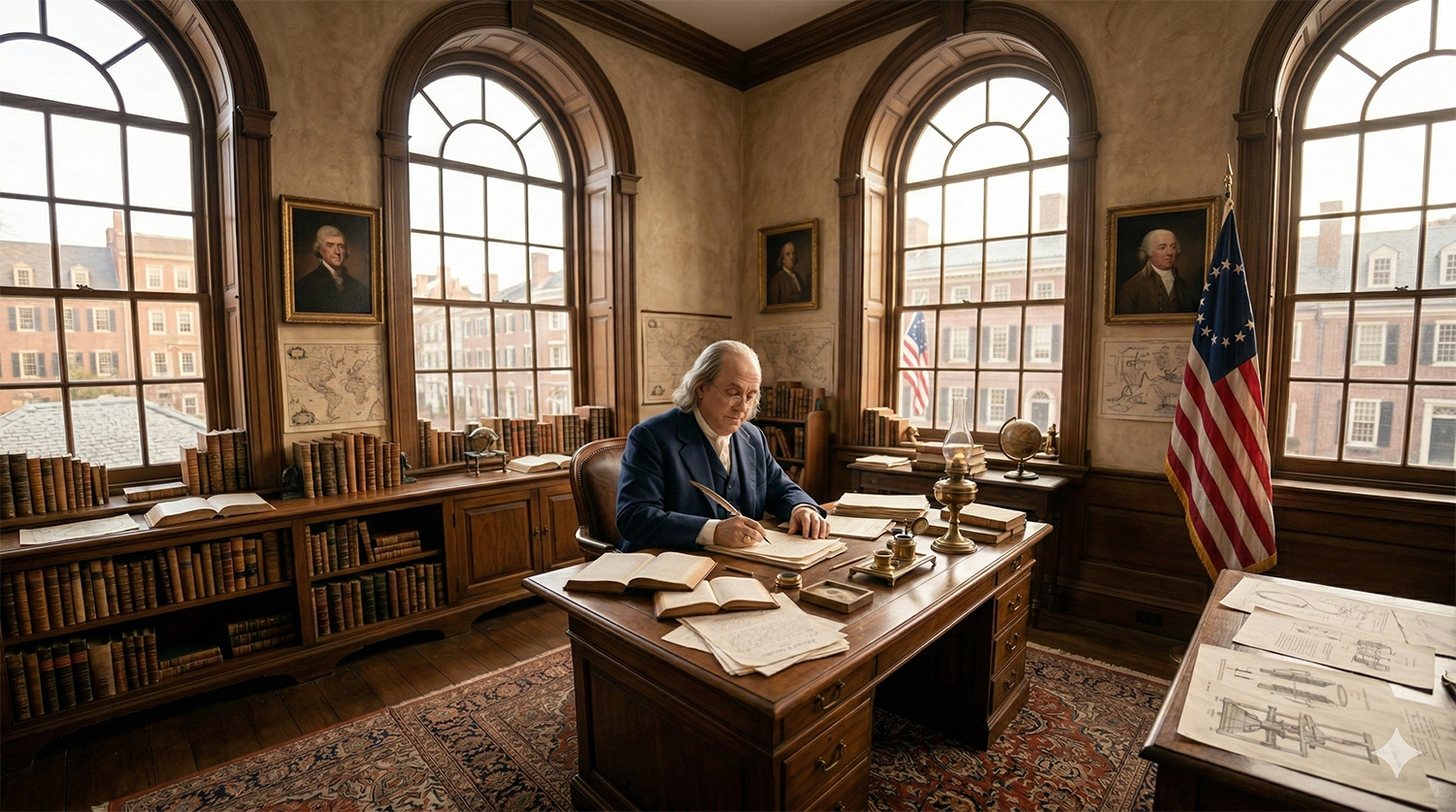
Benjamin Franklin was a printer, scientist, inventor, diplomat, and one of the most influential figures in American history. He is the only person to have signed all four major founding documents of the United States: the Declaration of Independence, the Treaty of Alliance with France, the Treaty of Paris, and the U.S. Constitution (The Franklin Institute). Born in 1706 as the 15th of 17 children to a Boston candle maker, he had just two years of formal schooling — yet became the most famous American of the 18th century.
His face has appeared on the $100 bill since 1914 (U.S. Currency Education Program). Six institutions he founded still operate today. His scientific terminology — "positive," "negative," "charge," "conductor," "battery" — is used billions of times daily. And the story of how he got there remains one of the most remarkable in American life.
How Did Franklin Go From Runaway to Renaissance Man ?
At age 12, Franklin was apprenticed to his older brother James, a Boston printer. By 16, he was secretly writing satirical essays under the pen name "Silence Dogood" — a fictional widow whose columns became so popular that readers sent marriage proposals for the made-up character (Britannica).
At 17, he ran away from his apprenticeship and arrived in Philadelphia carrying bread rolls up Market Street, observed by Deborah Read, his future wife. Within a decade, he owned the most successful newspaper in the British colonies — the Pennsylvania Gazette — and launched Poor Richard's Almanack, which sold roughly 10,000 copies per year for 25 consecutive years (Library of Congress).
By age 42, he had earned enough from printing to retire. He spent the remaining 42 years of his life on science, public service, and diplomacy.
What Did Franklin Invent and Discover?
Franklin's scientific contributions went far beyond the famous kite experiment. In June 1752, he flew a kite during a Philadelphia thunderstorm and proved that lightning was electrical in nature — but contrary to popular myth, the kite was not struck by lightning. It collected ambient charge from the storm clouds, and Franklin felt a spark when he touched the key tied to the string (The Franklin Institute).
His inventions spanned decades and disciplines:
- Lightning rod (by 1749) — Pointed iron rods to protect buildings from lightning strikes, quickly adopted across the colonies and still the standard method worldwide after 270 years
- Bifocals — "Double spectacles" combining distance and reading lenses in one frame, the basis for modern progressive lenses
- Franklin stove (1742) — A metal-lined fireplace that heated rooms more efficiently with less smoke
- Glass armonica (1761) — A musical instrument using rotating glass bowls on a spindle, for which Mozart, Beethoven, and Strauss composed music. Franklin called it "the greatest personal satisfaction" of all his inventions
- Swim fins (age 11) — Oval wooden hand paddles, his earliest invention. He was later inducted into the International Swimming Hall of Fame
- Flexible urinary catheter (1752) — An improvement over rigid metal designs
- Gulf Stream chart (1770) — The first formal mapping and naming of the Gulf Stream, created with his cousin Timothy Folger, a Nantucket whaling captain (Library of Congress)
He coined the electrical terms still used today: "positive," "negative," "charge," "conductor," and "battery" (The Franklin Institute). And he never patented a single invention, believing they "should be shared freely and generously" for humanity's benefit.
What Role Did Franklin Play in American Independence?
Franklin's diplomatic career may have mattered more than any invention. From 1776 to 1785, he spent nine years in France as America's representative — first as commissioner, then as Minister Plenipotentiary (U.S. Department of State).
On February 6, 1778, he secured the Treaty of Alliance with France, the diplomatic breakthrough of the Revolution. French military and financial support — estimated at roughly $20 billion in modern value — proved decisive in winning independence (HISTORY). His celebrity in Paris was extraordinary: French women created oversized wigs called "coiffure a la Franklin" to imitate his fur cap, and his likeness appeared on medallions, rings, watches, and snuffboxes.
In 1783, he signed the Treaty of Paris, ending the Revolutionary War. In 1787, at age 81, he became the oldest delegate at the Constitutional Convention — so physically frail that he was carried to sessions in a sedan chair (National Archives). Too weak to deliver his own closing speech, he had James Wilson read it. He was instrumental in brokering the Great Compromise that balanced representation between large and small states.
One of his final public acts, in February 1790, was signing an antislavery petition as president of the Pennsylvania Abolition Society. He died two months later at age 84.
What Institutions Did Franklin Create That Still Exist?
Franklin didn't just invent objects — he built organizations. Several still operate more than two centuries later:
- Library Company of Philadelphia (1731) — America's first subscription lending library, the model for modern public libraries. Still open at 1314 Locust Street, Philadelphia.
- American Philosophical Society (1743) — The nation's first learned society, still active in Philadelphia promoting scholarly research.
- University of Pennsylvania (1749) — Now an Ivy League research university and one of the most prestigious institutions in the world.
- Pennsylvania Hospital (1751) — The nation's first hospital, co-founded with Dr. Thomas Bond. Still operates as part of Penn Medicine.
- Philadelphia's first volunteer fire company (1736) — Established the model for volunteer fire departments across America. Volunteer firefighters still make up roughly 65% of all U.S. firefighters today.
- The U.S. Postal Service (1775) — Franklin was appointed the first Postmaster General. His organizational work — including relay teams that cut delivery times in half — laid the foundation for the system still running today (HISTORY).
Even his death produced a lasting institution. His will left 1,000 pounds each to Boston and Philadelphia with instructions to compound the funds for 200 years. By 1990, the trusts had grown to approximately $4.5 million in Philadelphia and $2 million in Boston, helping fund the Franklin Institute and the Benjamin Franklin Institute of Technology (The Franklin Institute).
What Made Franklin Different From the Other Founders?
While Washington was a general, Jefferson a planter-philosopher, and Adams a lawyer, Franklin was entirely self-made. He had two years of formal education. He built his fortune through printing and publishing. He taught himself science by reading and experimenting. His Autobiography — one of the most influential American memoirs ever written — documented his self-improvement system: 13 virtues (Temperance, Silence, Order, Resolution, Frugality, Industry, Sincerity, Justice, Moderation, Cleanliness, Tranquility, Chastity, and Humility) that he tracked in a notebook every evening.
He was also the wittiest of the founders. His quips endure: "In this world nothing can be said to be certain, except death and taxes" (letter to Jean-Baptiste Le Roy, 1789). "Three may keep a secret, if two of them are dead." "We must all hang together, or assuredly we shall all hang separately" — reportedly said at the signing of the Declaration of Independence.
He held at least eight government positions, from Philadelphia Postmaster to President of the Pennsylvania Supreme Executive Council. He served as Pennsylvania's agent in London for 11 years before the Revolution. He was a vegetarian in his teens (to save money on books), a chess theorist, a composer of string quartets, and a swimmer passionate enough to earn posthumous induction into the International Swimming Hall of Fame.
Key Takeaways
- Franklin signed all four founding documents — the only person to do so
- He invented the lightning rod, bifocals, the Franklin stove, the glass armonica, and swim fins, patenting none of them
- His nine years of diplomacy in France secured the military and financial support that won the Revolution
- Six institutions he founded still operate today, including the University of Pennsylvania and the U.S. Postal Service
- He had two years of formal education and retired wealthy at 42 from his printing business
Why Franklin Still Matters
Benjamin Franklin's life bridged the gap between individual achievement and public service in a way that defined the American character. His inventions still protect buildings, correct vision, and carry mail. His institutions educate, heal, and preserve knowledge. His words — "an investment in knowledge pays the best interest," "time is money," "nothing is certain but death and taxes" — are woven into everyday English.
He proved that curiosity, discipline, and generosity could reshape the world. Three hundred years after his birth, we're still living in the one he helped build.
What part of Franklin's legacy surprises you the most?